32
E. W. Beatty Steps Up
![[Sir Edward Beatty.]](/images/sir_edward_beatty_gbe_soe_382_small.jpg "Sir Edward Beatty.")
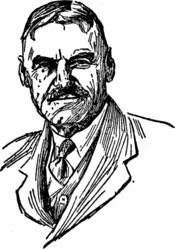
Sir Edward Beatty, G.B.E.
FAILING eyesight and indications of physical strain warned Lord Shaughnessy towards the end of the war period that he must find a successor in the presidency. About a year before the decision was made, he was on a tour of inspection and in answer to an enquiry as to what the C. P. R. proposed to do about a certain work replied:
"I could probably answer your question, but there is a young fellow further down the platform who could tell you a whole lot of things about the C. P. R. that I couldn't tell you."
The young fellow was E. W. Beatty, son of the Henry Beatty whom Van Horne had chosen to operate the Great Lakes Steamships and to advise on the designs for the first Empresses on the Pacific Service. Just a year before that, Beatty had been described by a friend as
"a man who just the other day was a boy, and who still regards life as a game of Rugby."
In his student days at Toronto University, he played quarterback in the Junior and Intermediate Canadian Championship Games, Boxing was another of his favourite sports. He has retained in after years the physique developed in these games the typical boxer's walk, springy and yet firm his heavy shoulders and arms a little bent, suggesting a wary yet aggressive boxer, or a quarterback ready to pass the ball or alert to tackle an opposing player. Wary and yet aggressive alertness were certainly needed for the job of tackling the problems facing the railway.
E. W. Beatty was himself the first Canadian-born president of the Canadian Pacific, and his appointment was a sign of the times. While the initial financing of the railway had to come largely from British, European or American houses, and a number of executive posts went in the early days to American railroad men with wider experience of construction and operation than could be found at the time in Canada, the control from the inception remained in Canada, and the personnel of both shareholders and officials became more and more Canadian. The example of Van Horne and Shaughnessy in becoming Canadian citizens was followed by other Americans who remained in service in Canada. Those of British origin required no naturalisation papers and automatically became Canadian, in spirit as well as in fact, after a very short residence. Fourteen of the seventeen directors shown in the annual report dated March xx, 1935, are resident in Canada, with two in England and one in New York. Of the 34 general officers shown in the annual report of x9x8, the first under E. W. Beatty's presidency, only three were born in the United States, the rest being Canadian by birth or of British extraction and resident from youth in Canada. As regards the shareholders, in 1883 there were 525 shareholders. In 1934 there were 72,741 holders of ordinary stock, of whom 30,202 were Canadian; 21,391 British; 16,603 citizens of the United States; 4,545 holders in other countries. The preference stocks are and always have been held chiefly by British investors who look upon the Canadian Pacific as the financial barometer of Canada, and number 27,653 out of a total of 27,967 of the holders.
E. W. Beatty graduated into the legal department of the Canadian Pacific from the office of A. R. Creelman, K. C., in Toronto, and he rose rapidly in Shaughnessy's confidence and esteem. Combined with infinite capacity for taking pains was a sense of humour, and a sympathy for the problems of fellow officers and employees.
He had ample opportunity to get acquainted with their individual problems, for in the operations of a company with such wide ramifications, every day brings a host of questions requiring legal advice.
Grant Hall, who came from Winnipeg to be vice-president in Montreal when E. W. Beatty was appointed president, delighted to tell the story of an interview with.his chief when he was called upon to cut down expenses at the Angus shops, Any reduction at the time in question could only be made by a reduction in staff, so he brought in a list of men that might be laid off. It was a cold wintry day. "E. W.," as he was popularly termed, looked at the list and then out of the window where a blizzard was raging. All he said was:
Grant Hall, a notable Vice-President
"This is a helluva day to let men out, Grant. Let's forget it."
Speaking to the York Bible Class in a reminiscent vein, E. W. Beatty said:
"In the year 1894 I entered Toronto University as a freshman in Arts. Like many other young men, I had no definite purpose in going to a university. My parents, like many other parents before them and since then, had a general idea that a university education would be a valuable asset to a young man, and that he would go farther with it than without it.... My father was a North of Irelander, and we all know that the North of Irelander is simply a glorified edition of a Scotsman, and they have many of the characteristics of the Scotch. We know that Scotsmen take their religion, their liquor and their education seriously, and of all the peoples in the world they have made the most consistent use of all three. And so it happened that I took an Arts course, with the hazy idea that later I would study medicine. I had an older brother who was destined for the law, but he changed his mind and decided to become a doctor. Automatically, I turned to the study of law, and it was not till years after that I realized I had made a mistake and that I should have entered the ministry. However, I did the next best thing and became a railway man... the language of both professions is very similar."
To a writer in MacLean's Magazine he said:
"My big problem was our relations with the public. These relations grew out of the new railway situation in Canada the C. P. R. had come suddenly into juxtaposition and competition with its own Government."
The bubble of unlimited capacity for railway lines in Canada had been burst by the war. A Royal Commission, delegated in 1916 to investigate, pointed out that while in 1901 Canada had 18,100 miles of railway for 5,370,000 inhabitants, or one mile for 300 inhabitants, in 1916 it had 40,384 miles for 7,500,000 inhabitants, or one mile for 185 inhabitants as compared with one mile for 400 inhabitants, in the United States. The Grand Trunk Pacific, itself in financial difficulties, had repudiated in 1915 its contract to operate the 2007 miles of National Transcontinental between Winnipeg and Moncton, which the government had therefore tacked on to the old Intercolonial Railway. Still more damaging was the admission by the Grand Trunk on December tenth of the same year that it was unable to fulfil its obligations with respect to the Grand Trunk Pacific. While the parent company had paid dividends to holders of guaranteed and preference stocks, its ordinary shareholders had been left in the cold. The Canadian Northern, with heavy Provincial Government guarantees, was threatening to bring down the financial credit of the provinces in its own collapse.
On August 1, 1917, the government took over the Canadian Northern with all its obligations, paying ten million eight hundred thousand dollars to its stockholders in the following year for sixty per cent of the stock, the balance of forty per cent having already been deposited with the government in exchange for a guarantee of bonds. The railway was merged with the Intercolonial, the combined system being renamed the Canadian National Railways in June, 1919. On March 10, 1919, the Grand Trunk Pacific was taken over by the Minister of Railways and Canals as receiver, and on December thirty-first of the same year the Grand Trunk itself came limping into the government hospital.
The Press Gallery at Ottawa, which exercises a genial freedom of speech at its annual banquets, sang a chanson to suit the occasion:
"Railway Rosary
—Air of God Save the King
"God gave the C. P. R.
Engine to parlour-car,
Save the C. P.!
Send them some more George Hams,
Soften newspaper slams,
Ward off the people's dams,
Save the C. P.!
"God help the C. N. R.
Bring back the line to par,
Save the C. N.!
Save it from Bill and Dan,
Eddie or Lomer Gouin,
Or other bogey man,
Save the C. N.!
"Shareholders spread afah!
Throughout this broad Empah!
Save the Grand Trunk
Save it from Arthur Meighen,
Save it from Smither-een,
Or any other has-been,
Save the G. T.!"
The final co-ordination took place on October 4, 1922 when Sir Henry Thornton, an Anglicized American, was appointed chairman with apparently quenchless thirst for draughts from the Dominion Treasury and a board of more or less political directors for the combined System now known as the Canadian National Railway Company.
Lord Shaughnessy foresaw the danger to Canadian credit that must inevitably follow so unscientifically planned a government-owned railway system, particularly if its constitution were left open to political pressure. In April, 1922, entirely on his own account as a private citizen, and without implicating the directors or shareholders of the Canadian Pacific, he addressed to the Right Honourable Arthur Meighen, Conservative premier, a method of dealing with the problem which might, he thought, save the Grand Trunk from extinction and enable it to remain privately owned and operated. He suggested that the land lines of the Canadian Pacific in Canada might be separated from its other interests and operated with the government lines by the Canadian Pacific under a contract to administer the whole property for account of the Canadian people, eliminating uneconomic duplication of track branch lines, terminals and services, the Canadian Pacific shareholders to be guaranteed a dividend on the capital involved in their contribution.
The Shaughnessy plan, however, did not receive any acknowledgment from Ottawa, and the two railway lines were left side by side to fight each other for traffic in a sparsely populated territory, one privately owned and described by the Royal Commissioners Report of 1932 as having
"brought faith, courage and invincible energy to the task of building its lines through the undeveloped west. The Company's achievement commanded the admiration of both railway operators and the public, and has been a material factor in causing Canada to be favourably known upon three continents. Their operations brought profit to shareholders, and the enterprise became a national asset of acknowledged value and importance to the Dominion."
The other line was government-owned and operated, a conglomeration of systems built to compete with one another and therefore impossible of efficient operation as one unit, too heavy with unnecessary mileage, but able to draw on its adopted governmental parent for money to meet its deficits, expenses and extensions on a scale permitting of reckless prodigality. At the same time everything possible was done to handicap the Canadian Pacific in its plans for development. The policy of the public ownership protagonists who were endeavouring to wring the neck of the Canadian Pacific and transfer its profits to the government railway reminds one of the fable told by Aesop the Greek about six hundred years before Christ.
"The Goose with the Golden Eggs"A certain man had the good fortune to possess a Goose that laid him a Golden Egg every day. But dissatisfied with so slow an income, and thinking to seize the whole treasure at once, he killed the Goose; and, cutting her open, found her—just what any other goose would be!"
The ostensible reason given for the government policy was to provide competition and prevent the other systems from being "gobbled up by the C. P. R." The word "monopoly" was a red rag to many political bulls. In the address to the York Bible Class, from which some extracts have already been given, E. W. Beatty dealt with this mental attitude:
"The Corporation with which I am associated is very extensive in character, with widely spread and varied activities. It is and has been the most outstanding enterprise of this country, and the largest transportation enterprise in the world. When in. the earlier days it enjoyed what amounted to a complete railway monopoly in certain parts of Canada, it was unpopular. Whether it deserved that unpopularity or not I cannot say, but I can assert with reasonable confidence that no Corporation could in that atmosphere and in these times be a monopoly and still be popular. When competing Systems grew up, without any marked change in its methods, it regained a great deal of its popularity... because the public, with other systems and their services before it, had a yardstick whereby it could measure the virtues and shortcomings of all systems."
Facing the facts, the Canadian Pacific went ahead developing its own system as a fast overland route between Europe and the Orient, and playing a major part in the settlement of the west and in the development of the land, timber, mineral, tourist and other resources of Canada, so that adequate traffic should be available for its transcontinental lines.
The front had now been transferred from Europe to Canada, with an opposing system of state operated railways and the still more formidable problem of renewing and strengthening the main transcontinental line to meet changing conditions of transportation, of keeping pace with new developments in railway engineering, of reducing labour costs by mechanical improvements. Thousands of miles of track were replaced with heavier steel and rock-ballasted, bridges were rebuilt to carry heavier locomotives, steel-framed cars replaced old wooden equipment, terminal and station facilities were enlarged to take care of longer trains, equipment of the most modern type was built or purchased, in fact the whole line was remodelled and modernised. These improvements made possible the acceleration and extension of train services, with numerous changes in operating methods devised to meet the menace of new forms of transportation. Within a decade the Canadian Pacific was built up to a condition of efficiency equal to any in the world. Lines were extended into undeveloped territory, and the purchase (in spite of strong political opposition) and reconditioning of the Northern Alberta Railways put the seal of permanence on the settlement of the fertile Peace River District hitherto lacking facilities for export. Worth noting is that as soon as purchase was completed, the Canadian Pacific offered a half interest in the Northern Alberta Railways to the Canadian National, who agreed to purchase. In this way the temptation to duplicate was wisely avoided. Hitherto the policy of the rival system seemed to aim at making two lines of railway grow where only one grew before.
Even still more vital to the growth of the company than reconditioning of the roadbed and equipment was the necessity of keeping up the morale of officers and employees who had hitherto been accepted as working for Canada's greatest enterprise and now found themselves facing the implication that this privately owned and operated railway was an interloper on the people's rights. As E. W. Beatty stated in an address to the Canadian Political Science Association:
"The Canadian Pacific suffered more than any other individual from the course followed by the Canadian National during nine years. As the largest single tax-payer in the country, it had to help to pay the bills for a campaign organized for its own discomfiture. It saw territory, which it had nursed and developed, invaded by a competitor with all the resources of the nation behind it. It had to stand by while nation-wide appeals were made to its patrons and friends to forsake it on patriotic and tax-saving grounds."
Here is where generalship of the highest order was required, the organising ability which kept the whole human machine on the tiptoe of efficiency, the dominating personality which infected every C. P. R. man with the spirit of courage.
So far from weakening under this political flank attack, the Canadian Pacific was evidently determined to stand its ground, otherwise this enormous programme would not have been undertaken. And it was not only on the railway lines that things were being done, The whole system from Liverpool to Hong Kong was evidently being revitalised and rearmed for a vigorous campaign of continued expansion.
E. W. Beatty inherited from his father, Henry Beatty, a keen interest in ships, and the growth of the steamship interests and operations under his regime has been spectacular. The additions to the fleet from 1920–30 involved an investment of ninety-five million dollars, or one-fourth of the expenditure on the whole system during that period, and nearly four times as much as the original capital of the company.
The loss of so many ships, and the wear and tear of others, involved a heavy programme of replacement and reconditioning, all the more costly since postwar conditions had tripled the price of ship-building in England and strikes delayed the completion of such orders as were given. The necessity of reconditioning made it possible to adopt oil instead of coal for fuel—a change which was welcomed by the more broadminded labour leaders, as living conditions for stokers in the old style of coal burning steamer were unavoidably oppressive, and though the oil burner required fewer men, at least this was no longer a dangerous trade. The Kaiserin Auguste Victoria, formerly the flagship of the Hamburg-American fleet, was thus reconverted into the Empress of Scotland. The cabin type of ship eliminating first-class passenger rates was introduced and became so popular that H. R. H. Prince George elected to travel that way. For the Pacific the Tirpitz was bought from the Reparations Commission, but, after trial, was brought back to be entirely re-engined, and now plies on the Atlantic and on cruises as the Empress of Australia. The enormous increase in cost of repairs, material and labour led, in 1920, to a request for increase in the mail subsidy given by the Dominion Government for the Pacific service. This the post office refused, going so far as to transfer six thousand sacks of mail from the hold of the Empress of Asia to a Japanese liner. What was lost to Canadian business by the use of slower Japanese vessels was gained by American business, as American mail now came forward in large quantities to fill the vacant holds. Canadian business men took advantage of this by sending their mail to the States to have American stamps put on and thus go to the Orient as American mail, until the situation was righted. In 1922 the Empress of Canada was added to the Pacific fleet at a cost of over five million dollars.
In 1925 the Atlantic fleet was strengthened by a building programme of four new vessels of an improved cabin type, each of twenty thousand five hundred tons, named after four Duchesses, and five fast freight boats, each of ten thousand gross tons, to maintain a weekly cargo service between London and Canada. One result of the steamship building programme was that in 1927 the Canadian Pacific carried more passengers from Europe and Great Britain to North America than any Atlantic Line New York Lines included.
Due to the development of her waterpowers, as well as of her natural resources, Canada was becoming a manufacturing country, depending largely for her progress on export business, and this was an additional reason why the steamship service received so much attention from the Canadian Pacific. Where there is commerce, there is the commercial traveller; freight and passenger business go hand in hand. The more recent addition of the new twenty-six thousand ton Empress of Japan to the Pacific Service and of the new forty-two thousand five hundred ton Empress of Britain to the Atlantic Service, both making speed records as well as providing a new standard of comfort to the ocean traveller, is typical of E. W. Beatty's progressive policy. The credit for the success of the modernised Canadian Pacific fleet in developing high speed with economical fuel consumption goes to John Johnson, a genius in marine engineering.
The original conception of the Canadian Pacific as a short route to Japan and China with fleets on both Atlantic and Pacific was expanded under the Beatty regime to a world-wide organisation with ports of call for cruising steamships in North, East, South and West Africa, in India, Ceylon, the Malay Peninsula, Java, Bali, the Philippines, as well as Hawaii, China and Japan, in the Mediterranean, in Scandinavia and the Baltic, in South America and the West Indies. Honolulu became an alternative port of call between Vancouver and the Orient. Purchase of a half interest in the Canadian-Australasian Line in 1931 provided direct connection with Suva, New Zealand and Australia, and brought into definite existence the All Red Line which Lord Strathcona had endeavoured to promote thirty years before. Starting at first with tentative cruises to the West Indies in 1922, the cruise organisation has grown to be the largest of its kind in th world. Its ramifications may be realised from the figures of z93y, which show that thirty-seven special trains were chartered in Palestine, Egypt, India, Malay Straits, Cambodia, China and Japan, not to mention six thousand automobiles at the various ports of call and bullock carrios, camels and elephants as required where trains or automobiles were not available. The world-wide ramifications of the Canadian Pacific organisation may be illustrated from the fact that in order to make out the monthly balance it is necessary to turn fifty-nine different currencies into dollars to give an accurate result in Canadian money.
The co-ordination of rail and steamships under one management has enabled the Canadian Pacific to make speedier transfers of freight at the terminal ports, a service particularly valuable where so much of the merchandise in transit has to be kept at a uniform temperature. Today cars with overseas shipments are loaded where possible with the merchandise on four wheel trucks, which are picked up by a tractor to within convenient reach of the ships tackle, and then lifted bodily into the hold. Such facilities have been particularly valuable to the Canadian Pacific in retaining its through traffic between Europe and the Orient, a very large tonnage of general merchandise being carried in addition to the more specialised shipments of silk and lily bulbs.
Commensurate with the expansion of the fleet and development of ocean traffic was the enlargement of the hotel system operated by the Canadian Pacific. The Château Frontenac at Quebec was virtually rebuilt between 1923 and 1927 with the addition of a central tower. A new fireproof Château replaced the flame- swept wooden building at Lake Louise in 1925. The Banff Springs Hotel was rebuilt between x926 and 1928 as a fireproof and much more capacious hostelry. Regina, the capital of Saskatchewan, rejoiced in a new hotel in 1927, and two stories were added to the Palliser Hotel in Calgary. The Empress Hotel at Victoria was enlarged by a new wing in 1929. The Royal York, the largest hotel in the British Empire, was opened in the same year at Toronto. Nova Scotia got the Pines at Digby, the Cornwallis at Kentville, and the Lakeside Inn at Yarmouth, in r93r. Throughout this period, chalet-bungalow camps were opened as summer resorts for outdoor lovers at various centres in the Canadian Rockies and the backwoods of Ontario. At Montebello, in the Province of Quebec, the Seigniory Club was taken over from an American syndicate and operated on a more comprehensive scale. The Canadian Pacific has been the pioneer in creating a tourist industry for Canada, and has reaped the benefit of its foresight, as its hotels serve the highways as well as the railway and welcome the new army. of automobile tourists whose invasion of the field of travel might otherwise have proved damaging.
Cortes, Pizarro and the Conquistadors found all the gold and silver they desired in Mexico and Peru, so that the Spanish expeditions to Cathay went no farther than America. If Canada had been known to possess such mineral wealth as has been developed in more recent years, there might have been less incentive for the Canadian Pacific to press on to the Orient, for the Dominion today produces more gold than Mexico and more silver than Peru. When the Canadian Pacific took over the smelter at Trail as part of a railway charter, no one realised that this was ultimately going to develop into one of its major subsidiary enterprises. While substantial profits were made out of the mining and treatment of the gold and silver of Rossland and the Kootenays, the enormous extension of the Consolidated Mining and Smelting Company followed the selective oil-flotation processes for the separation of zinc and lead which were developed in the Tadanac laboratories in z920 and perfected in 1923. This made the Sullivan mine one of the richest producers in the world, with a concentrator of six thousand tons daily capacity. The average annual production of the Consolidated now exceeds thirty million dollars, and the power projects developed for the requirements of its various plants will shortly approximate five hundred thousand horse power. It now operates the largest non-ferrous metallurgical plant in the world, and employs five thousand men in its mines and smelters. As a traffic producer, the Consolidated Mining and Smelting Company contributes an average of three million four hundred thousand dollars in freight revenues each year. The exploration work of the company is carried out chiefly by the subsidiary Solar Development Company, which employs ten aero- planes.
Chemical research employs many University graduates, resulting, for instance, in the investment of ten million dollars on a plant for the manufacture of chemical fertiliser from waste gasses and by-products. E. W. Beatty, as chancellor of McGill University, always believed in research as applied to all forms of engineering, considering that the pioneer of today has to seek adventure as much in the laboratory as in the remote fastnesses of mountain ranges.
The discovery of natural gas in Alberta was made in drilling for the water supply of Langevin Station, near Medicine Hat, and later discoveries were made near Calgary in boring operations conducted by the railway company. The most spectacular development of naphtha and gas, however, began in 1923 when Royalite No. 4 was brought into production in Turner Valley and which has produced, up to date, over a million barrels of naphtha and much of the supply for the Calgary gas system.
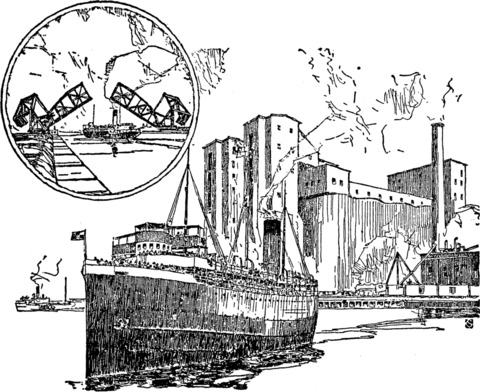
Great Lakes Steamship at Port McNicoll
Inset—Bascule Bridge over Canal at Sault Ste. Marie.
Another feature of E. W. Beatty's presidency was a more systematic method of colonisation than that which prevailed before the war. Experience had shown that true colonisation does not end with selling land to the settler. Conditions have to be made favourable to his success and contentment as a farmer, and while much of this work might be considered to be rather the function of a government, E. W. Beatty was convinced that the railway is more than a means of transport. This is the keynote of many of his public utterances, as for instance:
"I believe the day is past when Corporations can hold themselves aloof from the struggle for community benefit."
In the colonisation field this has shown itself in the establishment since the war of three colonies of one hundred farms with ready-made houses for war veterans, the organisation of the Clan- donald Colony of one hundred and twenty farms, the preparation of one hundred farms for British colonists under an arrangement with the Hudson's Bay Company, the erection of cottages for reception of British colonists looking for farm employment, the One Thousand Family Scheme planned in co-operation with the British Government, the education in Canadian conditions and placing of over eleven thousand British women, the placing of nearly five thousand British boys of "teen" age, the distribution of livestock to encourage mixed farming, the operation of demonstration farms at a cost of nearly a million dollars, co-operation with the British Re-Union Association in enabling settlers who have come out in advance of their families to bring out these families, the supervision of fourteen hundred farms over an area of four hundred and seventy thousand acres, providing expert farm management and financial assistance, assistance in the organisation of National Colonisation Boards to receive and assist in the settlement of immigrants from Continental Europe. Under the Ready Made Farm policy, twelve hundred and fifty-five improved, loan and demonstration farms had been established by 1927 and in the single year of 1926 approximately fifty thousand immigrants from Europe were placed on farms or in agricultural employment with eight hundred and twenty-five additional settlers from the United States. The knowledge of these activities and of this programme of continued expansion inspired a feeling of confidence throughout the whole Canadian Pacific force, and it was realised that in E. W. Beatty there was a leader no less far-seeing and constructive and no less dynamic than any of his three great predecessors in the presidency.
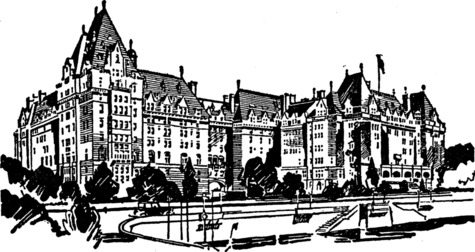
Empress Hotel, Victoria, B. C.
![[Public Domain]](../imagesc/norights.png)